

Bio-Based Nonionic Surfactants Market Forecast Report Featuring Segment Analysis And Strategic Industry Insight
News originally published by
EIN Presswire
The Business Research Company
Bio-Based Nonionic Surfactants Market
The Business Research Company’s Bio-Based Nonionic Surfactants Global Market Report 2026 – Market Size, Trends, And Forecast 2026-2035
LONDON, GREATER LONDON , UNITED KINGDOM, November 25, 2026 /EINPresswire.com/ -- The bio-based nonionic surfactants market has witnessed significant development recently, driven by increasing environmental awareness and evolving consumer preferences. This segment of the surfactant industry is rapidly gaining traction as businesses and consumers alike prioritize sustainability and the use of eco-friendly materials. Below is a detailed examination of the market’s size, key drivers, trends, segments, regional dynamics, and major players shaping its future.
Growth Trajectory and Market Value of the Bio-Based Nonionic Surfactants Market
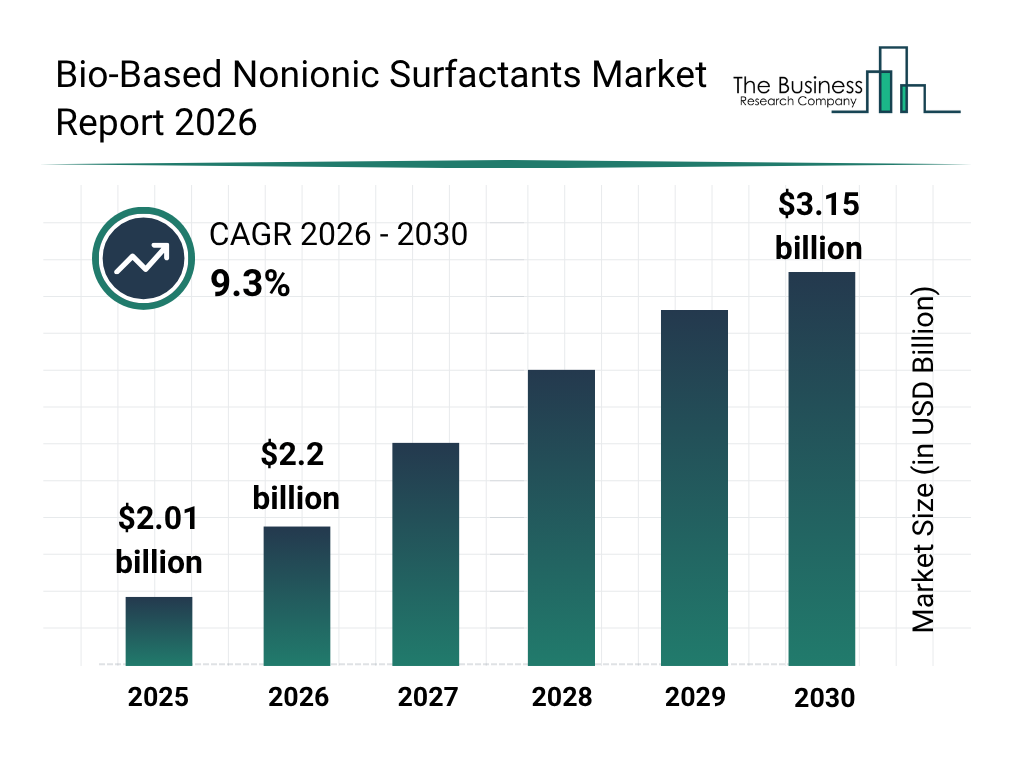
In recent years, the bio-based nonionic surfactants market has experienced solid growth. It is projected to rise from $2.01 billion in 2025 to $2.2 billion in 2026, reflecting a robust compound annual growth rate (CAGR) of 9.7%. This upward trend during the previous period was largely influenced by the demand for biodegradable cleaning solutions, a shift toward plant-based surfactants, consumer preferences for sustainable personal care items, expanded use of bio-based ingredients in industrial cleaning, and the need for environmentally friendly agricultural products.
Looking ahead, the market is expected to continue its strong momentum, reaching $3.15 billion by 2030 with a CAGR of 9.3%. Several factors support this anticipated expansion, including stricter regulations aimed at reducing persistent chemicals, rising demand for renewable surfactants in consumer goods, broader adoption of bio-based ingredients in institutional cleaning products, increased use in sustainable oilfield chemicals, and a preference for high-performance biodegradable surfactants. Emerging trends include a rise in plant-derived feedstocks, growing interest in highly biodegradable surfactant formulations, increased use of low-toxicity surfactants, and expanded applications across various formulation types.
Download a free sample of the bio-based nonionic surfactants market report:
https://www.thebusinessresearchcompany.com/sample_request?id=14418535&type=smp&name=Bio-Based%20Nonionic%20Surfactants%20Market%20Report%202026&utm_source=EINPresswire&utm_medium=Paid&utm_campaign=Nov_PR
Renewable Feedstock Adoption as a Catalyst for Market Expansion
One of the primary forces propelling growth in the bio-based nonionic surfactants market is the increased use of renewable feedstocks and circular materials. These raw materials, sourced from renewable natural origins like plant oils, sugars, and agricultural byproducts, along with recycled or regenerated resources, are gaining popularity due to environmental concerns. Governments, industry players, and consumers are motivated to reduce carbon footprints, minimize waste, lower reliance on fossil resources, and support sustainable manufacturing practices.
This shift boosts demand for bio-based nonionic surfactants because these products offer biodegradable, renewable, and eco-friendly alternatives to petrochemical surfactants. They also align with circular economy principles by emphasizing resource efficiency and waste reduction. For example, in April 2026, LyondellBasell Industries N.V., a Netherlands-based chemical manufacturer, announced plans to produce and market 800,000 metric tons of recycled and renewable polymers annually by 2030, revising an earlier target of 2 million metric tons per year set in February 2026. Such initiatives underscore the role of renewable feedstocks in driving market growth.
Key Segments Defining the Bio-Based Nonionic Surfactants Market Structure
The bio-based nonionic surfactants market is divided into several essential segments to provide clarity on product types, sources, forms, applications, and end-users.
1) By Product Type: Alkyl Polyglucosides, Fatty Alcohol Ethoxylates, Sorbitan Esters, Sucrose Esters, and Other Product Types
2) By Source: Plant-Based, Animal-Based, and Other Sources
3) By Form: Liquid, Paste, Powder or Flakes, and Blends or Systems
4) By Application: Detergents and Cleaners, Personal Care, Industrial and Institutional Cleaning, Agriculture, Oilfield Chemicals, and Other Applications
5) By End User: Household, Industrial, Commercial, and Other End Users
Further subcategories break down each product type. For instance, Alkyl Polyglucosides include Caprylyl Capryl Glucoside, Coco Glucoside, Decyl Glucoside, Lauryl Glucoside, and Cetearyl Glucoside. Fatty Alcohol Ethoxylates cover Lauryl, Cetyl, Stearyl, Oleyl, and Cetearyl Alcohol Ethoxylates. Sorbitan Esters comprise Sorbitan Monolaurate, Monopalmitate, Monostearate, Monooleate, and Trioleate. Sucrose Esters include Laurate, Palmitate, Stearate, Oleate, and Erucate. The “Other Product Types” category features Polyglycerol Esters, Methyl Glucoside Esters, Alkyl Lactates, Fatty Acid Esters, and Ethoxylated Methyl Esters.
View the full bio-based nonionic surfactants market report:
https://www.thebusinessresearchcompany.com/report/bio-based-nonionic-surfactants-market-report?utm_source=EINPresswire&utm_medium=Paid&utm_campaign=Nov_PR
Innovative Trends Transforming the Bio-Based Nonionic Surfactants Market
Leading companies in this market are pioneering new bio-based surfactants to enhance sustainability and product performance. An example is the development of bio-based furan-structured nonionic surfactants, which combine renewable feedstocks with advanced chemistry to replace traditional petrochemical ingredients. These surfactants offer improved cleansing ability, milder formulations, and reduced environmental impact.
For example, in March 2026, Sironix Renewables Inc., a US-based green chemistry company, unveiled Furasoft-SF, a next-generation bio-based nonionic surfactant tailored for personal care products. Made from upcycled feedstocks, Furasoft-SF is 100% bio-based and sustainably sourced, offering 65 to 75 percent lower greenhouse gas emissions compared to conventional petrochemical surfactants. It is free from PEG, sulfates, nitrosamines, and 1,4-dioxane, and delivers rich, stable foam with enhanced formulation flexibility. This surfactant integrates easily into manufacturing processes for shampoos, body washes, and hand soaps, demonstrating both environmental and functional benefits.
Regional Growth Drivers and Market Outlook for Bio-Based Nonionic Surfactants
In 2025, Asia-Pacific emerged as the largest regional market for bio-based nonionic surfactants and is expected to maintain its lead in growth over the forecast period. The market report also covers key regions such as South East Asia, Western Europe, Eastern Europe, North America, South America, the Middle East, and Africa, providing a global perspective on market trends and regional dynamics. Asia-Pacific’s dominance is driven by expanding industrialization, increasing regulatory support for sustainable products, and growing consumer awareness about environmental impacts.
Top Companies Leading the Bio-Based Nonionic Surfactants Market
Several prominent corporations are steering innovation and market expansion in the bio-based nonionic surfactants sector. These include BASF SE, The Dow Chemical Company, Syensqo SA, Arkema, Huntsman Corporation, Evonik Industries AG, Clariant AG, Wilmar International Limited, Croda International Plc, Sasol Limited, Kao Corporation, Stepan Company, Musim Mas Holdings Pte. Ltd., Godrej Industries Limited, Innospec Inc., Emery Oleochemicals, Galaxy Surfactants Limited, Ecogreen Oleochemicals Pte. Ltd., VVF Limited, Kuala Lumpur Kepong Berhad, Zschimmer & Schwarz GmbH & Co KG Chemische Fabriken, Colonial Chemical Inc., PCC Exol S.A., and Lankem Limited. These companies are heavily invested in research, sustainable practices, and expanding product portfolios to meet rising global demand for renewable surfactants.
Our 2026 market reports now feature expanded strategic intelligence through market attractiveness scoring and analysis, total addressable market (TAM) analysis, company scoring matrix graphics and tables, Excel-based dashboards, market hotspots infographics, key technology and future trend analysis, along with updated graphics and tables.
Speak With Our Expert:
Saumya Sahay
Americas +1 310-496-7795
Asia +44 7882 955267 & +91 8897263534
Europe +44 7882 955267
Email: marketing@tbrc.info
The Business Research Company - www.thebusinessresearchcompany.com
Follow Us On:
• LinkedIn: https://in.linkedin.com/company/the-business-research-company
Oliver Guirdham
The Business Research Company
+44 7882 955267
info@tbrc.info
Visit us on social media:
LinkedIn
Facebook
X
Legal Disclaimer:
EIN Presswire provides this news content "as is" without warranty of any kind. We do not accept any responsibility or liability for the accuracy, content, images, videos, licenses, completeness, legality, or reliability of the information contained in this article. If you have any complaints or copyright issues related to this article, kindly contact the author above.
